
Is your cold call script working against you?
Cold call scripts are the backbone of any successful outbound sales strategy, yet most of them fail within the first ten seconds. If your reps are hearing “not interested” before they even finish their opening line, there’s a good chance the script itself is the problem, not the person delivering it.
Here’s the thing: a well-crafted cold call script does not just tell your team what to say. It guides the entire conversation, from the opening hook to objection handling, and ensures every outbound call moves prospects one step closer to a booked meeting. Whether you’re launching a new product, qualifying leads, or re-engaging dormant prospects, the right phone script makes all the difference.
In Australia’s competitive B2B market, cold calling remains a critical part of sales prospecting and pipeline growth. Many companies combine strategic phone outreach with targeted digital engagement to connect with decision-makers. In fact, pairing your scripts with a broader B2B telemarketing and lead generation strategy can dramatically improve both your reach and conversion rates.
In this guide, you’ll learn:
- The anatomy of winning cold call scripts
- Proven phone script templates
- Best practices for B2B cold calling
- How to customise customer service scripts for product launches
Whether you’re a seasoned sales development representative or new to outbound sales, this resource will help you refine your calls and start turning conversations into qualified opportunities.
Got the sales team but still missing appointments?
The Anatomy of a Winning Cold Call
Before jumping into templates, it helps to understand what makes a cold call script work in the first place. A strong call is not just a monologue but a structured, two-way conversation designed to earn trust, uncover pain points, and guide the prospect toward a clear next step.
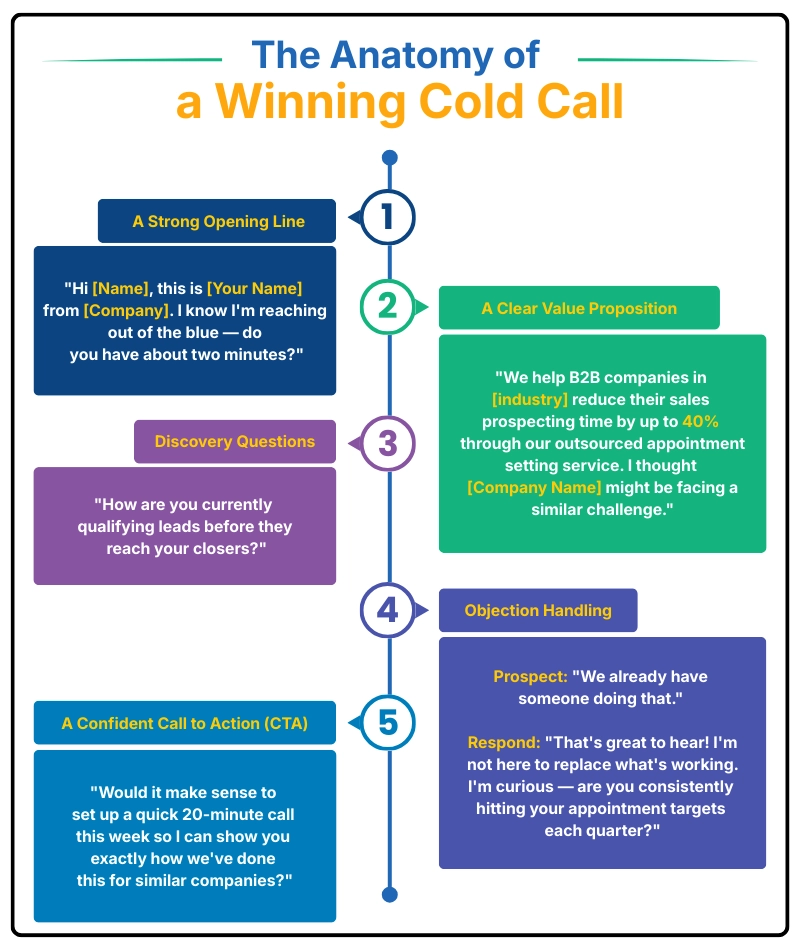
Here is what a high-performing B2B cold call typically includes:
1. A Strong Opening Line
The first five seconds of your call determine whether the prospect keeps listening. A permission-based opener tends to work well here.
Instead of launching straight into your pitch, you acknowledge their time:
“Hi [Name], this is [Your Name] from [Company]. I know I’m reaching out of the blue — do you have about two minutes?”
This kind of opener respects the prospect’s attention, which immediately sets a different tone from a hard-sell telemarketing call.
2. A Clear Value Proposition
Once you have their attention, you need to deliver your value statement quickly and clearly. What do you do, who do you do it for, and — most importantly — what pain point do you solve? Keep it to two or three sentences.
For example:
“We help B2B companies in [industry] reduce their sales prospecting time by up to 40% through our outsourced appointment setting service. I thought [Company Name] might be facing a similar challenge.”
Once you have permission, you need to communicate your value statement quickly and clearly. Your elevator pitch should answer one core question the prospect is silently asking: “Why should I care?”
Notice how it focuses on outcomes, not features. That distinction matters enormously in B2B cold calling.
3. Discovery Questions
After the value statement, shift into active listening mode.
This is where many reps go wrong. They talk too much. Instead, shift the conversation toward open-ended questions that uncover the prospect’s situation.
For example:
“Can I ask — what does your current outbound process look like?” or
“How are you currently qualifying leads before they reach your closers?”
Good discovery questions create dialogue and help you with lead qualification on the spot. This also allows you to personalise your pitch and demonstrate genuine interest, which goes a long way in rapport building.
4. Objection Handling
Every cold call script needs to account for pushback. Objection handling is one of the most critical skills in outbound sales, and preparing for common objections in advance means you will never be caught off guard.
You see, objections are not the end of the call. They’re a signal that the prospect is engaged. The key to effective objection handling is active listening and positive scripting. Acknowledge the concern, reframe it, and bridge back to value.
For example:
Prospect: “We already have someone doing that.”
Respond: “That’s great to hear! I’m not here to replace what’s working. I’m curious — are you consistently hitting your appointment targets each quarter?”
Prospect: “Now’s not a great time.”
Respond: “Totally understand. When would be a better time? I can send a quick email first, so you have some context before we chat.”
Prospect: “We’re not interested.”
Respond: “Fair enough. Before I let you go, can I ask — is it because [specific challenge] isn’t a priority right now, or is there a different reason?”
The goal of an objection rebuttal is not to argue — it is to keep the dialogue open and gather information.
5. A Confident Call to Action (CTA)
Every cold call should end with a clear, low-friction ask. Rather than pushing for the sale, aim to book a discovery call or demo.
“Would it make sense to set up a quick 20-minute call this week so I can show you exactly how we’ve done this for similar companies?”
A specific, easy-to-say-yes-to CTA dramatically improves your conversion rate at the end of the call.
See how we generate qualified meetings for B2B companies.
Phone Scripts and Cold Calling Templates
Now that you understand the structure, here are several ready-to-use templates you can adapt for your team.
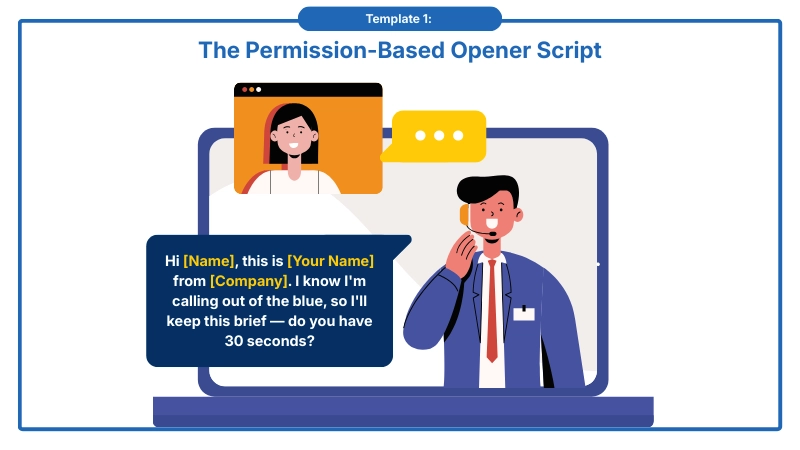
Template 1: The Permission-Based Opener Script
Rep: “Hi [Name], this is [Your Name] from [Company]. I know I’m calling out of the blue, so I’ll keep this brief — do you have 30 seconds?
(Prospect responds)
Rep: We work with [industry] companies in Australia to help them [specific outcome — e.g., shorten their sales cycle / generate more qualified leads]. I’m calling because we’ve recently helped a few businesses similar to yours achieve [result], and I thought it might be worth a quick conversation. Would you be open to a 15-minute call this week to see if there’s a fit?”
Best for: First-touch outbound calls to cold prospects. Works especially well for B2B cold calling targeting senior decision-makers.
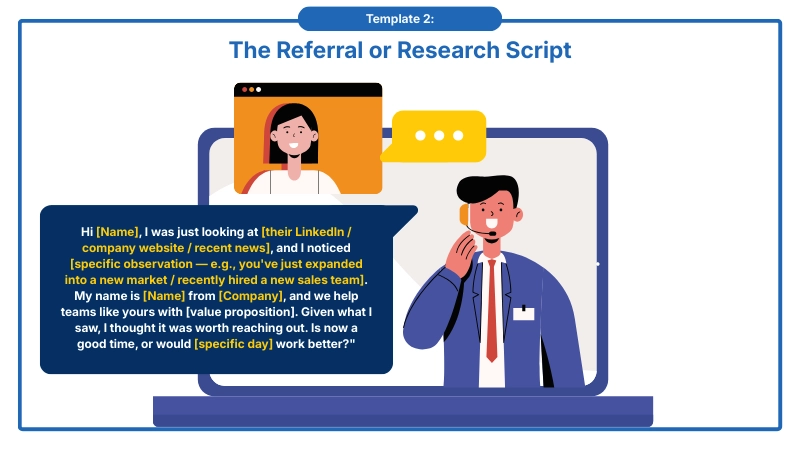
Template 2: The Referral or Research Script
Rep: “Hi [Name], I was just looking at [their LinkedIn / company website / recent news], and I noticed [specific observation — e.g., you’ve just expanded into a new market / recently hired a new sales team]. My name is [Name] from [Company], and we help teams like yours with [value proposition]. Given what I saw, I thought it was worth reaching out. Is now a good time, or would [specific day] work better?”
Best for: Warm calling and prospect engagement after doing pre-call research. Using a referral or research approach shows genuine interest, which significantly improves rapport building from the start.
Template 3: The Gatekeeper Strategy Script
Gatekeepers are not obstacles — they’re allies, if you approach them right.
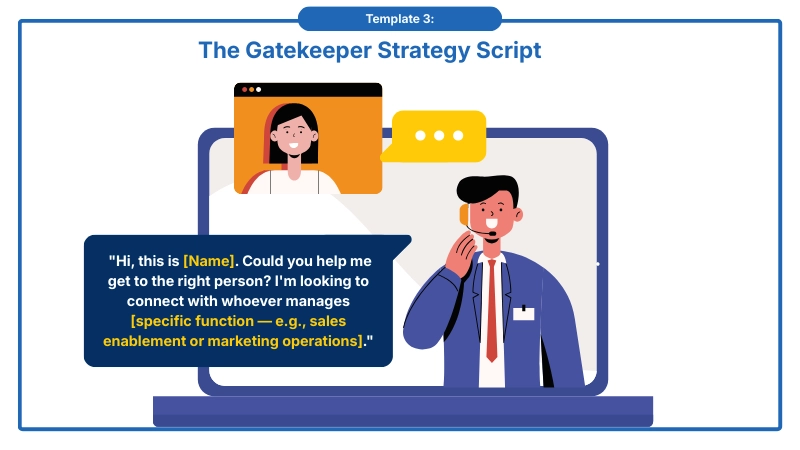
Rep: “Hi, this is [Name]. Could you help me get to the right person? I’m looking to connect with whoever manages [specific function — e.g., sales enablement or marketing operations].”
Avoid over-explaining yourself to gatekeepers. Keep it confident, brief, and professional. If they ask why you’re calling, say:
“I have some information relevant to their [goal/initiative] — I want to make sure it gets to the right desk.”
This gatekeeper cold calling approach avoids triggering the instinctive refusal reflex.
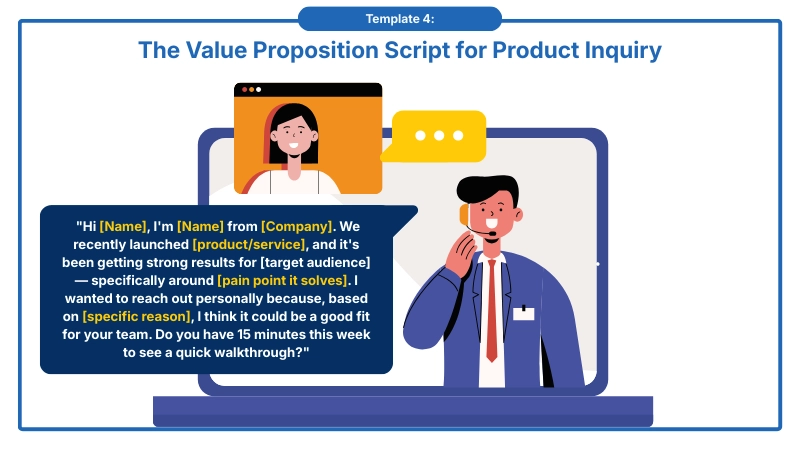
Template 4: The Value Proposition Script for Product Inquiry
Rep: “Hi [Name], I’m [Name] from [Company]. We recently launched [product/service], and it’s been getting strong results for [target audience] — specifically around [pain point it solves]. I wanted to reach out personally because, based on [specific reason], I think it could be a good fit for your team. Do you have 15 minutes this week to see a quick walkthrough?”
Best for: Product launch outreach and outbound sales calls tied to a new offering or seasonal campaign.
For more industry-specific inspiration, check out our cold calling scripts resource for all industries — it’s a practical starting point for teams across different verticals.
Cold Calling Best Practices for the Australian Market
Scripts alone won’t save a poor outbound process. So, alongside your templates, keep these cold calling best practices in mind.
1. Know the rules.
Australia has specific regulations around outbound calling. The Do Not Call Register Act means you must scrub your lists against the national Do Not Call list before dialling. Unlike the US Telephone Consumer Protection Act (TCPA), Australia’s framework focuses heavily on consent and list compliance, so make sure your data team is on top of cold calling compliance before any campaign goes live.
2. Time your calls strategically.
Cold calling time best practices in Australia suggest that mid-morning (10–11 am) and late afternoon (4–5 pm) AEST tend to produce the best answer rates. Avoid Monday mornings and Friday afternoons — prospects are either catching up or already mentally checked out.
3. Keep your CRM updated.
Whether your team uses Pipedrive CRM or any other platform, logging every call outcome in real time is non-negotiable. This helps you track follow-up calls, measure conversion rates, and refine your scripts based on what’s actually working.
4. Personalise before you dial.
Use LinkedIn for prospecting to gather quick intel on your prospect before each call. Even a single personalised detail — a recent company announcement, a shared connection, or a relevant pain point — can be the difference between a hang-up and a booked meeting.
5. Train for active listening.
The best cold callers are not the best talkers — they’re the best listeners. Train your team to pause after asking discovery questions, mirror language when appropriate, and resist the urge to fill silence with more selling.
6. Test and iterate your scripts.
No script is perfect from day one. Run A/B variations on your opening lines, value statements, and CTAs. Track which versions improve your booking rate, and update your scripts at least once a quarter.
See how an IT Solutions Firm boosts sales appointments in 3 months.
Can You Help Me Customise a Customer Service Script for a New Product Launch?
Absolutely, and this is one of the most common requests B2B sales and support teams have when rolling out something new. A product launch script needs to do a few things at once: generate excitement, handle a higher-than-usual volume of enquiries, and ensure your team delivers a consistent, confident message across every touchpoint.
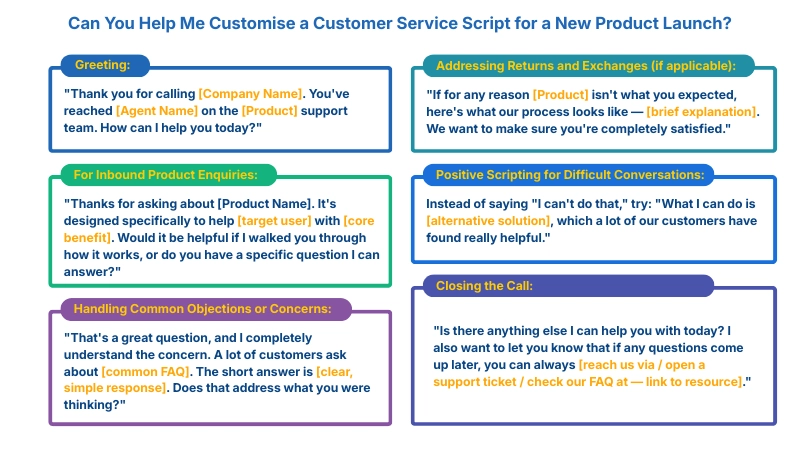
Here’s a customisable customer service call script framework you can adapt for your product launch:
Product Launch Customer Service Script Template
Greeting:
“Thank you for calling [Company Name]. You’ve reached [Agent Name] on the [Product] support team. How can I help you today?”
For Inbound Product Enquiries:
“Thanks for asking about [Product Name]. It’s designed specifically to help [target user] with [core benefit]. Would it be helpful if I walked you through how it works, or do you have a specific question I can answer?”
Handling Common Objections or Concerns:
“That’s a great question, and I completely understand the concern. A lot of customers ask about [common FAQ]. The short answer is [clear, simple response]. Does that address what you were thinking?”
Addressing Returns and Exchanges (if applicable):
“If for any reason [Product] isn’t what you expected, here’s what our process looks like — [brief explanation]. We want to make sure you’re completely satisfied.”
Positive Scripting for Difficult Conversations:
Instead of saying “I can’t do that,” try: “What I can do is [alternative solution], which a lot of our customers have found really helpful.”
Closing the Call:
“Is there anything else I can help you with today? I also want to let you know that if any questions come up later, you can always [reach us via / open a support ticket / check our FAQ at — link to resource].”
Tips for customising this script:
- Adjust agent tone to match your brand voice. Whether that’s professional and formal or conversational and friendly.
- Build empathy in customer service by acknowledging emotions first, especially for frustrated customers during a product launch window.
- Use personalised responses wherever possible. Reference the customer’s name and account details if integrated with Zendesk or your CRM.
- Collaborate with your product team to pre-build an FAQ bank so agents can handle technical support script needs confidently from day one.
Stop guessing your scripts. Start booking real prospects.
Final Thoughts
A great cold call script is not a rigid reading exercise, it’s a flexible, human-centred conversation guide. When your team understands the anatomy of a winning call, follows Australian cold calling compliance rules, and uses scripts as a framework rather than a crutch, the results can be significant.
The Australian B2B market rewards persistence paired with relevance. Use the templates and best practices in this guide as your starting point, then refine them based on what your prospects actually respond to. Over time, your scripts become one of the sharpest tools in your outbound sales arsenal.