

Cold calling scripts give B2B callers a proven structure for opening the conversation, handling pushback, and asking for the meeting with confidence. A good script isn’t something you read word-for-word. It’s a safety net that keeps the call on track when a prospect throws you off, and it’s the fastest way to get a new caller sounding credible in week one instead of month three.
Callbox Australia has run B2B appointment setting campaigns for over 20 years, across industries including technology, logistics, healthcare and manufacturing. The pattern holds every time: callers working from a flexible script framework book more meetings than callers winging it, and they book far more than callers reading a rigid, word-for-word transcript.
Below is that framework in practice — ready-to-use scripts for the Australian industries we’re asked about most, the objection responses that keep a call alive when a prospect pushes back, and a compliance check so nothing here creates risk you didn’t sign up for.
Cold Calling Scripts by Industry
Use these as starting templates. Swap in your company name, offer, and target titles. Then read the script aloud a few times until it feels like your own voice, not a transcript.
Cold Calling Scripts for Technology Companies
This covers software, IT services, cybersecurity, cloud services, AI-driven platforms, CRM providers, and managed IT — the technology segment that makes up the largest share of AU B2B cold calling demand.
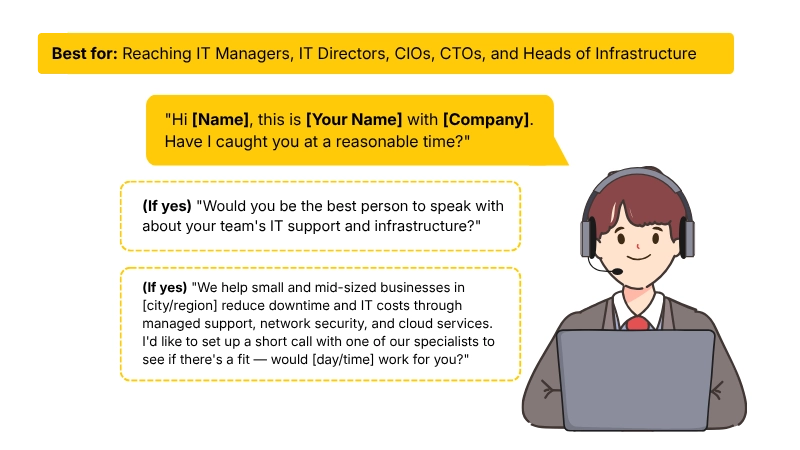
Best for: Reaching IT Managers, IT Directors, CIOs, CTOs, and Heads of Infrastructure
“Hi [Name], this is [Your Name] with [Company]. Have I caught you at a reasonable time?”
(If yes)
“Would you be the best person to speak with about your team’s IT support and infrastructure?”
(If yes)
“We help small and mid-sized businesses in [city/region] reduce downtime and IT costs through managed support, network security, and cloud services. I’d like to set up a short call with one of our specialists to see if there’s a fit — would [day/time] work for you?”
Qualifying questions to weave in:
- How is your IT currently supported — in-house, outsourced, or a mix?
- What’s your biggest frustration with your current setup?
- Are you locked into a contract, or open to exploring options?
“Based on what you’ve told me, it sounds like a short conversation with one of our specialists could be useful. Would you be open to that this week?”
(If yes)
“Great — would Wednesday at 10 am or Thursday at 2 pm work better? And what’s the best email for a calendar invite?”
Cold Calling Scripts for Healthcare and Medical Technology
This covers healthcare software, practice management platforms, clinical workflow tools, and health-tech vendors selling into Australian clinics, hospitals, and allied health providers. It does not cover clinical products or devices requiring therapeutic goods compliance — that’s a separate regulatory area outside the scope of this script.
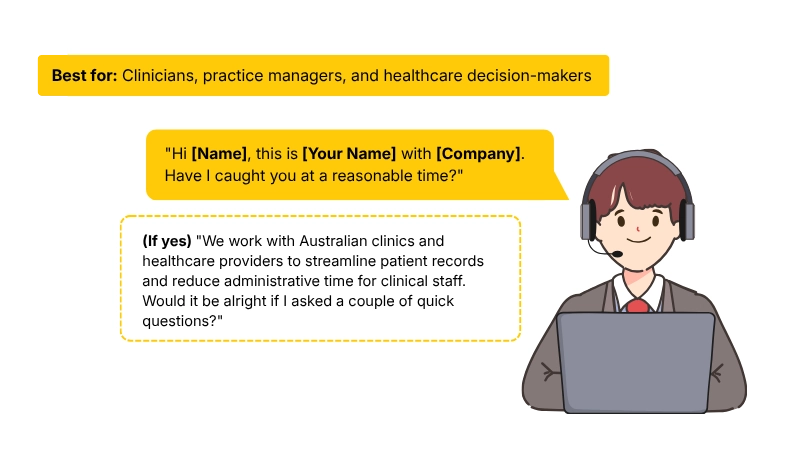
Best for: Clinicians, practice managers, and healthcare decision-makers
“Hi [Name], this is [Your Name] from [Your Company]— have I caught you at a workable time?”
(If yes)
“We work with Australian clinics and healthcare providers to streamline patient records and reduce administrative time for clinical staff. Would it be alright if I asked a couple of quick questions?”
Qualifying questions to weave in:
- What system are you currently using to manage patient records and scheduling?
- Is administrative workload currently a pain point for your clinical or front-desk staff?
- Are you evaluating any changes to your current systems in the next six to twelve months?
“That’s useful context. Based on what you’ve shared, a short call with our team could be worth your time. Would you be open to that?”
(If yes)
“Would Monday at 9 am or Wednesday at 1 pm suit better? And what’s the best email for the invite?”
(Confirm name, title, direct number, email before ending the call.)
“Thanks, [Name] — I’ll send that through now. Talk soon.”
Cold Calling Scripts for Manufacturing Companies
This covers manufacturers evaluating new suppliers, software, equipment, or process partners — a segment where cold calling still performs well because purchasing decisions often sit with a small, identifiable group.
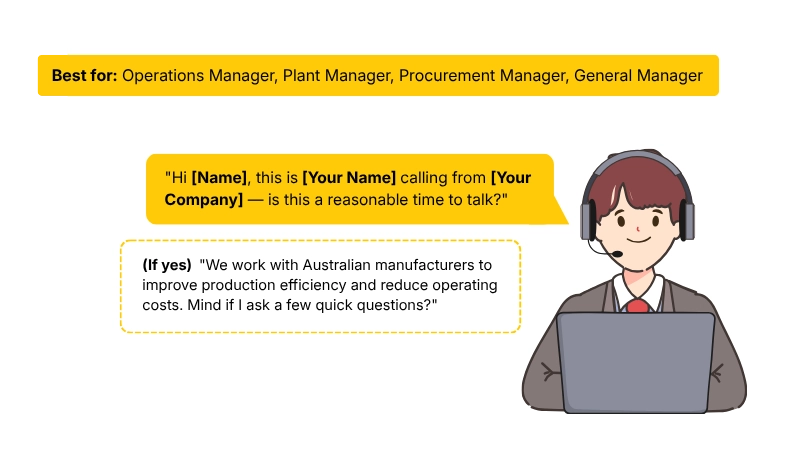
Best for: Operations Manager, Plant Manager, Procurement Manager, General Manager
“Hi [Name], this is [Your Name] calling from [Your Company] — is this a reasonable time to talk?”
(If yes)
“We work with Australian manufacturers to improve production efficiency and reduce operating costs. Mind if I ask a few quick questions?”
Qualifying questions to weave in:
- What does your current production or supply setup look like?
- Where are you seeing the most friction right now — output, cost, or supplier reliability?
- Are you currently reviewing any suppliers or processes, or locked in for the year ahead?
“Appreciate that. It sounds like it could be worth a short conversation with our team. Would you be open to that this week?”
(If yes)
“Would Thursday at 10 am or Friday at 2 pm work for you? What’s the best email for a calendar invite?”
(Confirm name, title, direct number, email before ending the call.)
“Thanks for your time, [Name]. I’ll get that invite over to you now.”
Cold calling script for logistics and supply chain companies
This covers fleet management platforms, logistics technology providers, 3PL and 4PL operators, freight brokers, and supply chain software vendors.
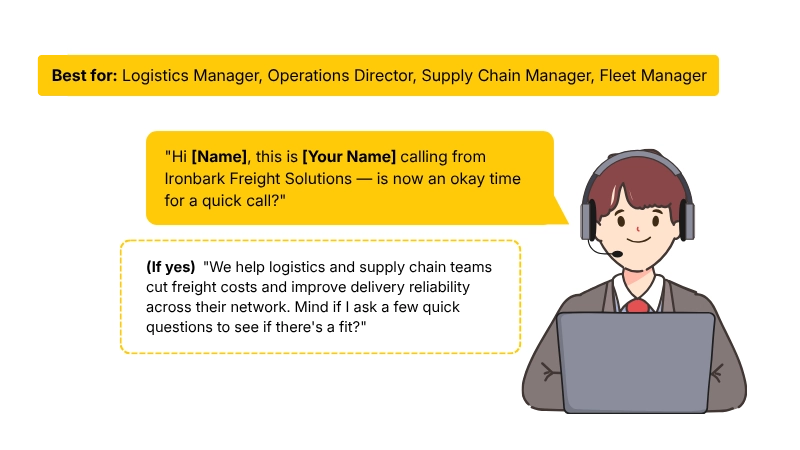
Best for: Logistics Manager, Operations Director, Supply Chain Manager, Fleet Manager
“Hi [Name], this is [Your Name] calling from Ironbark Freight Solutions — is now an okay time for a quick call?”
(If yes)
“We help logistics and supply chain teams cut freight costs and improve delivery reliability across their network. Mind if I ask a few quick questions to see if there’s a fit?”
Qualifying questions:
- Are you currently managing freight and fleet operations in-house or through a third-party provider?
- What’s your biggest current pressure point — cost, delivery times, or visibility across your fleet?
- Are you locked into a contract with your current provider, or is now a good time to look at options?
“That’s helpful, thanks. It sounds worth a short conversation with our team to see whether there’s a way to improve on what you’ve got. Would later this week suit?”
(If yes)
“Would Tuesday at 11 am or Wednesday at 3 pm work? What’s the best email to send the invite to?”
(Confirm name, title, direct number, email before ending the call.)
“Appreciate your time, [Name]. I’ll get that invite sent through — speak soon.”
The Cold Calling Script Framework Behind Every Example Above
Every script on this blog follows the same underlying structure, which is what makes it easy to adapt if your business sits outside these four industries. Swap in your own opener and qualifying questions, and the framework holds for almost any B2B industry; it’s the structure doing the work, not the industry-specific wording.
1. The Permission-Based Opener
Skip the fake-friendly “How are you today?” Instead, acknowledge the interruption. Then ask for a small amount of time. This single move can double your continuation rate compared to a generic greeting.
Example: “Hi [Name], this is [Your Name] with [Company]. I know I’m catching you out of the blue; do you have 20 seconds for me to explain why I called?”
2. The Relevance Statement
State who you help and the specific problem you solve, in one or two sentences. Avoid listing every service you offer. Instead, name the outcome your prospect actually cares about.
3. The Qualifying Questions
Ask two or three questions that confirm the prospect is a fit. These same questions should also uncover a real pain point. They do double duty, qualifying the lead while making the prospect feel heard, not sold to.
4. The Ask (Book the Meeting, Not the Sale)
The goal of a cold call is never to close a deal on the spot. It’s to earn a follow-up conversation with the right person. So ask directly for a specific day and time. Avoid a vague close like “would you be interested in learning more?”
5. The Confirmation and Wrap-Up
Confirm the date, time, and best contact details. Then tell the prospect exactly what happens next (a calendar invite, a follow-up email, or a colleague’s call). Clarity here reduces no-shows.
A note on objections: pair every script below with responses to common rebuttals. Think “we already have a provider,” “send me an email instead,” or “I’m not the right person.” Prepare two or three responses to each before you dial. That way, you’re never caught flat-footed.
For a deeper walkthrough of this framework, including gatekeeper-specific openers and objection scripting in more detail, see Callbox Australia’s full cold call scripts B2B playbook.
Handling the eight most common objections
Every one of these will come up. Having a rehearsed, natural-sounding response ready is what separates a caller who recovers the conversation from one who loses it.
“Just send me an email.” This usually means you haven’t earned the meeting yet, not that they’re not interested. “I’ll do that — and while I have you, can I ask one quick question so the email actually lands on the right thing?”
“We already have a provider.” “That’s good to hear — most of the businesses we now work with said the same thing before we started. Would you be open to a quick comparison, no obligation?”
“We’re in a contract.” “No problem at all — when does that come up for renewal? I’ll follow up closer to that date so you’ve got options when the time comes.”
“We’re not interested.” “Totally understand. Can I ask — is that because you’ve got this covered, or because it’s just not a priority right now?” This single follow-up question uncovers whether the door is fully closed or just not open yet.
“We don’t have the budget right now.” “Understood — budget’s often the reason timing matters. Would it be useful to have a conversation now so you’re ready when budget opens up?”
“Can you call back later?” “Of course — what time works best for you?” Always lock in a specific time. A vague “call me later” without a set time rarely converts to a second call.
Screened by reception. “No worries — I’ll try another time. Could you tell me the best time to reach [Name] directly?” Never argue with a gatekeeper. Build rapport instead.
Reaching voicemail. “Hi [Name], this is [Your Name] from [Company]. I’ll try you again in a couple of days, but if you’d like to reach me first, my number is [number]. Have a great day.” Keep it under 20 seconds.
How to Prepare Before Your First Cold Call
New to cold calling? Preparation is what separates a confident first call from a shaky one. Work through this checklist before you dial:
- Know your product cold. Write down key details about what you’re offering, and keep them visible during calls. Stumbling on basic questions is one of the fastest ways to lose credibility.
- Know your company details. Have your company name, location, and website ready without thinking twice — nerves make people forget the obvious.
- Rehearse your script three or four times. You should be able to deliver the opener and value statement without reading them word for word.
- Prepare rebuttals in advance. Ask a mentor or teammate what objections come up most often, and write down a response for each one before you start dialling.
Should You Build a Cold Calling Team In-House, or Outsource It?
Most B2B companies reach this fork once they’ve validated that cold calling works for them. The scripts above will get an in-house rep started. The harder question is whether hiring, training, and managing that rep is the best use of your team’s time.
In-house makes sense when:
- You have one or two dedicated SDRs and enough call volume to justify their full-time focus
- Your sales cycle depends on deep, ongoing product knowledge that’s hard to hand off
- You’re building a long-term sales bench and want direct control over training and coaching
Outsourcing makes sense when:
- You need to scale call volume quickly without a multi-month hiring and ramp-up cycle
- Your team’s calendars are already full of demos and closing work, not prospecting
- You want trained callers, verified contact data, and reporting ready from day one, instead of building it from scratch
- You’re testing a new market, industry vertical, or region — like AU or SG — and don’t want to commit to local headcount before you know the fit
Neither path is universally right. Companies with a tight, well-defined ICP and a long sales cycle often keep prospecting in-house. Companies scaling into new markets or industries usually see faster results a different way. They benefit more from an experienced outsourced team that’s already made the calls before, rather than spending months on hiring and training.
Why Teams Choose Callbox Australia’s B2B Telemarketing
A script fixes what happens on the call. It doesn’t fix a team that doesn’t have the hours to dial consistently, chase follow-ups, or keep a list clean. That gap is usually what separates a business with a good script from one that’s actually booking a full calendar of qualified meetings.
Callbox Australia runs appointment setting for B2B teams across technology, logistics, healthcare, manufacturing, and many more industries— the same four industries covered above. For teams that want the calling function handled end-to-end rather than run in-house, Callbox Australia’s sales outsourcing programme covers that too. Either way, Callbox books the qualified meetings; your own sales team runs the conversation and closes.
Every call we make follows Australia's telemarketing rules.
Meet the Callbox Team in Person at Tech Week Singapore 2026
If you’d rather talk through your cold calling strategy face-to-face than read about it, you’ll have the chance this September. Callbox is exhibiting at Tech Week Singapore 2026, and the team will be on-site to talk about appointment setting, lead generation, and what’s actually working for B2B teams in Singapore, Australia, New Zealand, and across APAC right now.
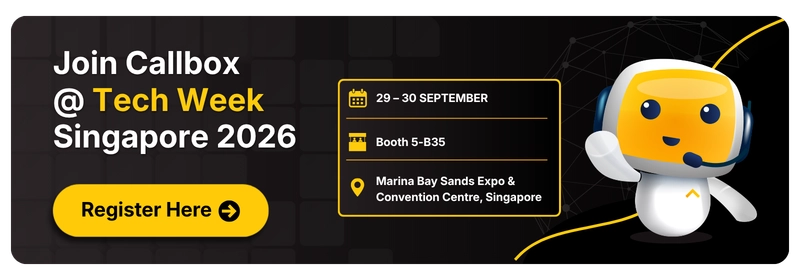
Event details:
- Dates: 29–30 September 2026
- Booth: 5-B35
- Venue: Marina Bay Sands Expo & Convention Centre, Singapore
Drop by the booth to talk shop, or lock in a time in advance so you don’t miss us on the floor.
Frequently Asked Questions About Cold Calling Scripts
Should I read my cold calling script word for word?
No. Use your script as a guide, not a transcript. Reading verbatim makes you sound robotic and reduces trust. Know your script well enough to speak it naturally, and adjust based on how the prospect responds.
How long should a B2B cold calling script be?
Your opener and value proposition should take no more than 30 to 45 seconds to deliver. The full script, including qualifying questions and objection handling, should fit on a single page.
What’s the difference between an appointment setting script and a data profiling script?
An appointment setting script is designed to book a meeting directly. A data profiling script has a different job. It focuses on confirming and collecting accurate contact details — job title, email, and direct line — so a follow-up call or campaign can be properly targeted.
How many attempts does it typically take to reach a prospect?
Most B2B teams need several attempts across multiple days to connect with a decision-maker. It often takes five or more total touches — calls, emails, and social outreach combined — before a prospect responds. Persistence, paired with a multi-channel approach, consistently outperforms cold calling alone.
Is it cheaper to outsource cold calling than hire an in-house SDR?
It depends on volume and timeline. A full-time in-house SDR carries salary, training time, tools, and data costs before making a single productive call. That ramp-up often takes two to three months. Outsourcing shifts that upfront cost into a predictable ongoing fee instead. Trained callers get on the phone immediately, which is usually more cost-effective for companies testing a new market or scaling call volume quickly.
Can an outsourced team use scripts tailored to my industry and market?
Yes. A good outsourced appointment-setting team builds custom scripts for your industry, offer, and target region, rather than using one generic template. At Callbox, every campaign starts with a script and messaging strategy built for the client’s specific ICP, industry, and target market. That includes region-specific nuances for markets like Australia, Singapore, and the US.
Considering Outsourced Appointment Setting? Here’s What That Looks Like With Callbox
Writing a script is one thing. Running it at scale, across the right industries and regions, with trained callers and clean data behind it, is where most in-house efforts stall.
Callbox has been building and running B2B cold calling and appointment-setting campaigns since 2004, across the US, Australia, and Singapore. Every campaign combines phone, email, LinkedIn, and web retargeting. Scripts are built for your specific industry and ICP, not a generic template. Our teams have handled more than 10,000 campaigns across 50+ industry verticals. That means the script for your industry has likely already been tested, refined, and improved before we write your first line.
If you’re weighing in-house versus outsourced, there’s a faster way to get a real answer than reading another guide. See what a campaign built for your industry and market would actually look like.