AI is no longer a future consideration for small and mid-sized businesses. It is an operational decision.
Across Australia and New Zealand, AI tools for small businesses are being adopted to address real pressures, rising costs, leaner teams, and increasing expectations around speed and customer experience. The challenge is not whether to adopt AI, but how to do so without eroding service quality or brand trust.
Leading SMEs are approaching AI differently.
Instead of replacing human interaction with automation, they are implementing the best AI tools for small businesses to eliminate low-value tasks, improve workflow efficiency, and enable teams to focus on revenue-generating and relationship-driven work. This approach is driving measurable ROI while preserving the human elements that differentiate strong brands.
As AI adoption in small and mid-sized businesses in Australia accelerates, decision-makers must cut through vendor hype and identify tools that integrate cleanly with existing systems, deliver fast time-to-value, and scale with the company.
This guide provides a practical overview of the best AI tools for small to mid-sized businesses in Australia across sales, marketing, finance, operations, and customer support so that leaders can make informed, low-risk adoption decisions.
Looking to reach high-intent buyers for your AI tool?
Why AI Adoption Is Accelerating Among Australian and NZ SMEs
The pace of AI adoption among SMEs is being driven less by innovation and more by necessity.
Australian and New Zealand businesses face a unique combination of challenges: high labour costs, geographically distributed customers, and increasing pressure to deliver enterprise-level experiences with limited resources. In response, many in Australia are turning to AI business software to support sustainable growth.
Key drivers include:
- The need for AI workflow automation to reduce manual admin
- Cloud-based ecosystems enabling faster deployment of AI software for small businesses
- Improved local compatibility with accounting, CRM, and communications platforms
- Growing confidence in AI security and compliance for businesses
For most SMEs, AI is becoming part of their everyday operations.
Selling AI in Australia? Explore how to reach CISOs and CIOs faster
What Defines the Best AI Tools for Small Businesses and Mid-Sized Companies?
Not all AI platforms are suitable for small or mid-sized organisations. The best AI tools for small businesses and mid-sized companies share several defining characteristics:
- Fast implementation with minimal technical overhead
- Clear, trackable AI tools ROI for small businesses
- Seamless AI CRM integrations and accounting integrations
- Transparent and scalable AI software Australia pricing
- Strong governance, data security, and compliance standards
These criteria should guide every evaluation, regardless of category or use case.
1. AI Marketing Tools for Scalable Demand Generation
Marketing is often the first function where small and mid-sized businesses see tangible value from AI. When implemented correctly, AI marketing tools help teams execute campaigns more efficiently, improve targeting accuracy, and generate demand without increasing headcount.
For Australian and New Zealand SMEs, the real value lies in tools that support campaign personalisation, content optimisation, and performance measurement, while integrating seamlessly with CRM and analytics platforms. These tools are not designed to replace marketers, but to remove manual execution and improve decision-making across channels.
Primary use cases
- Campaign planning and optimisation
- Content creation and refinement
- Audience segmentation and targeting
- Performance tracking and attribution
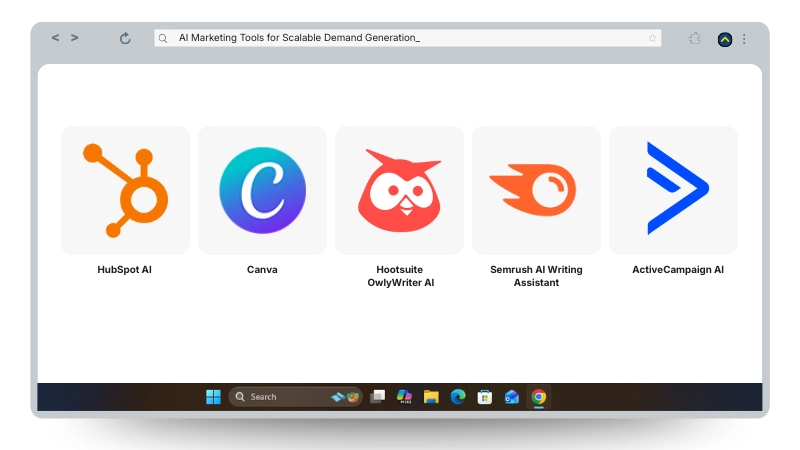
Here are some of the sample AI marketing tools you can use:
- HubSpot AI – AI-assisted content creation, email optimisation, and lead nurturing built directly into CRM workflows.
- Canva – Enables fast, on-brand creative production for non-design teams using AI-powered templates and copy suggestions.
- Hootsuite OwlyWriter AI – Automates social media copy creation, scheduling, and optimisation across multiple platforms.
- Semrush AI Writing Assistant – Supports SEO-driven content creation with real-time readability and optimisation analysis.
- ActiveCampaign AI – Combines marketing automation with predictive sending and audience segmentation for email-led growth.
See how an AI SaaS Firm leverages Callbox’s Human expertise + AI to accelerate revenue growth.
When evaluating the best AI tools for marketing SMEs, focus on pipeline impact, not vanity metrics.
See how an AI SaaS Firm leverages Callbox’s Human expertise + AI to accelerate revenue growth.
2. AI Sales Automation Tools for Revenue Efficiency
Sales teams in SMEs are often constrained by time rather than opportunity. AI sales automation tools help reduce administrative friction, prioritise high-value leads, and improve forecasting accuracy—allowing salespeople to focus on conversations that drive revenue.
These tools are particularly effective when integrated with CRM platforms, enabling automated follow-ups, intelligent lead scoring, and pipeline insights without manual data entry.
Primary use cases
- Lead scoring and prioritisation
- Automated outreach and follow-ups
- Deal forecasting and pipeline visibility
- CRM data enrichment and maintenance
Sample AI sales automation tools include:
- HubSpot Sales Hub AI – Automates lead scoring, email follow-ups, and deal forecasting within a unified CRM.
- Pipedrive AI Sales Assistant – Provides deal insights, activity recommendations, and pipeline forecasting.
- Apollo.io – Combines AI-driven prospecting, contact enrichment, and outbound sequencing for B2B sales teams.
- Salesforce Einstein (SME plans) – Delivers predictive insights, deal recommendations, and performance forecasting.
- Zoho CRM with Zia AI – Offers AI-powered lead scoring, workflow automation, and conversational analytics.
3. AI Chatbot Software and Customer Support Automation
Customer expectations around response time and availability continue to rise. AI chatbot and customer support tools enable SMEs to deliver consistent, responsive service without expanding support teams or sacrificing quality.
The most effective solutions balance automation with intelligent escalation—handling routine enquiries while routing complex issues to human agents.
Primary use cases
- Website chat and enquiry handling
- Support ticket categorisation and routing
- Self-service knowledge bases
- Sales and support conversation automation
Here are some of the sample AI chatbots and support tools you can use:
- Intercom AI – Automates customer conversations, ticket resolution, and sales qualification with human handoff.
- Zendesk AI – Uses AI to categorise tickets, suggest responses, and power self-service portals.
- Tidio AI – Lightweight chatbot software popular with e-commerce and service-based SMEs.
- Freshdesk AI (Freddy AI) – Automates responses, detects sentiment, and improves support workflows.
- Drift – Focuses on conversational sales and marketing chats for lead qualification and routing.
These capabilities are central to AI tools to automate customer service for small businesses, particularly in e-commerce and SaaS environments.
4. AI for Accounting, Finance, and Cash Flow Management
Finance teams in SMEs spend a disproportionate amount of time on manual processing and reconciliation. AI-powered accounting and finance tools reduce this burden while improving accuracy, compliance, and forecasting.
For Australian and New Zealand businesses, compatibility with local accounting platforms and regulatory requirements is critical.
Primary use cases
- Invoice and expense processing
- Cash flow forecasting
- Financial reporting and analysis
- Fraud and anomaly detection
Sample AI finance and accounting tools include, but are not limited to:
- Xero Analytics Plus – Provides AI-driven insights for forecasting and financial performance tracking.
- Vic.ai – Automates invoice processing and expense categorisation using machine learning.
- Dext – Extracts and codes financial data automatically to reduce manual entry.
- Fathom – Delivers AI-supported forecasting, reporting, and financial modelling for Xero and MYOB users.
- Airwallex Analytics – Combines payment data with AI insights for cash flow visibility across markets.
5. AI Project Management and Scheduling Tools
As teams become more distributed and workloads more complex, AI-powered project management tools help SMEs maintain clarity and delivery discipline. These platforms support prioritisation, resource allocation, and risk identification without excessive manual oversight.
Primary use cases
- Task prioritisation and workload management
- Delivery forecasting and risk alerts
- Workflow automation and reporting
- Cross-team visibility
Sample AI project management tools:
- ClickUp AI – Assists with task prioritisation, project summaries, and workflow optimisation.
- Monday.com AI – Automates updates and predicts delivery risks based on project data.
- Asana Intelligence – Supports workload forecasting and deadline risk detection.
- Notion AI – Combines documentation, task management, and AI-generated summaries.
- Motion – Automatically schedules tasks based on priorities, deadlines, and availability.
6. AI HR and Recruitment Software
Hiring inefficiencies are costly for growing SMEs. AI HR and recruitment tools streamline candidate screening, scheduling, and onboarding—reducing time-to-hire while improving candidate quality.
Primary use cases
- CV screening and candidate matching
- Interview scheduling and coordination
- Workforce planning and analytics
- Onboarding automation
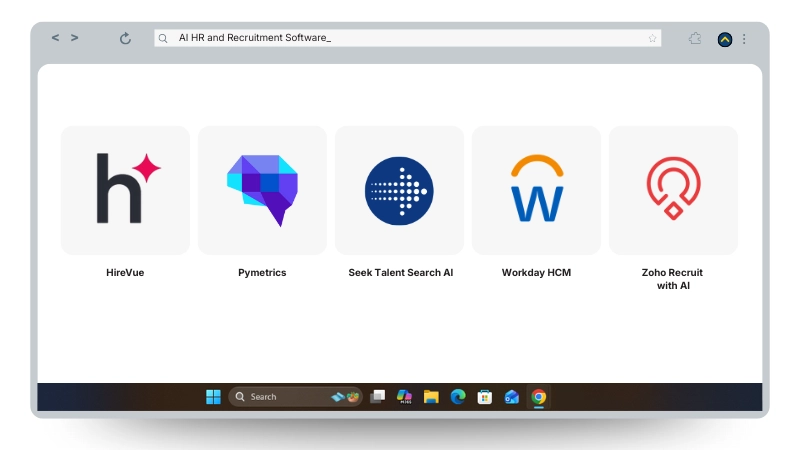
Sample AI HR and recruitment tools
- HireVue – Uses AI to assess candidate responses and support structured screening.
- Pymetrics – Matches candidates to roles using behavioural and cognitive data.
- Seek Talent Search AI – Helps Australian employers identify suitable candidates more efficiently.
- Workday HCM (SME offerings) – Provides AI-supported workforce planning and talent analytics.
- Zoho Recruit with AI – Automates screening, ranking, and interview scheduling.
7. AI Inventory and Operations Management
Operational forecasting directly affects profitability, particularly in retail, manufacturing, and distribution. AI inventory and operations tools help SMEs optimise stock levels, reduce waste, and improve demand planning.
Primary use cases
- Demand forecasting and replenishment
- Inventory optimisation
- Order and supply chain visibility
- Operations performance analytics
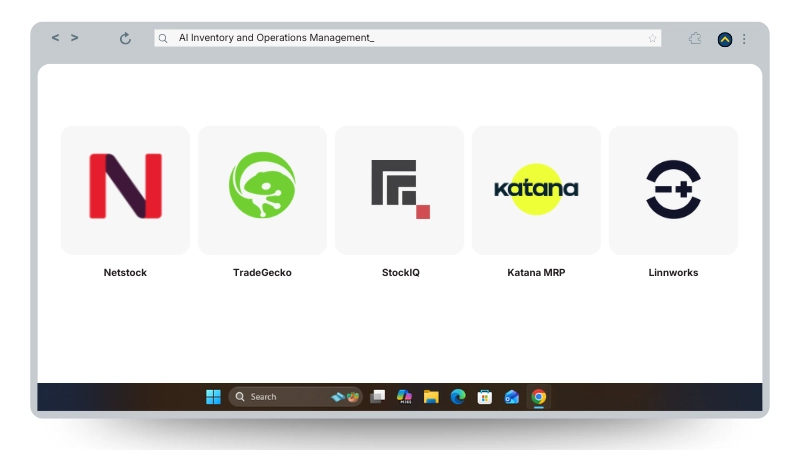
Sample AI inventory and operations tools
- Netstock – Uses predictive analytics to optimise inventory levels and demand forecasting.
- TradeGecko (QuickBooks Commerce) – Automates inventory and order management for e-commerce and wholesale.
- StockIQ – Applies AI-driven demand planning to reduce overstocking and stockouts.
- Katana MRP – Designed for manufacturers, supporting production planning and forecasting.
- Linnworks – Integrates inventory, order management, and analytics for multi-channel operations.
How to Choose the Right AI Tools for Your Business
Before investing, decision-makers should assess AI tools against five core questions:
- Which processes consume the most internal time today?
- Will the tool integrate with existing systems and data?
- How quickly will it demonstrate ROI?
- Can it scale with future growth?
- Does it meet AI security and compliance standards for businesses?
For most SMEs, success lies in targeted adoption—not tool sprawl.
Final Takeaway
The most effective AI strategies are intentional, measured, and aligned with business outcomes.
For Australian and New Zealand SMEs, adopting the best AI tools for your company is not about keeping up with trends. It is about building operational resilience, improving customer experience, and enabling sustainable growth in an increasingly competitive market.
The tools are ready. The advantage lies in choosing them well.